Allemannsretten in Norway: Your Right to Roam and its Limits
Allemannsretten—the Norwegian right to roam—is a precisely defined legal right that allows anyone to camp, picnic, and forage on uncultivated land, with restrictions on camping distance, stay length, and protecting cultivated land.
A Law, Not Just a Tradition – What Allemannsretten Is
The right to roam is an ancient practice rooted in Norway's Outdoor Recreation Act (Friluftsloven), originally adopted in 1957. Codified in Section 2 of the Act, it states, "Any person is entitled access to and passage through uncultivated land at all times of the year, provided that consideration and due care is shown." This means Norwegian citizens and foreign visitors alike may walk, ski, bike, swim, and camp on uncultivated land, regardless of ownership. [14][15]
Utmark vs. Innmark – Where You May Walk and Camp
Crucially, the Act draws a distinction between uncultivated (utmark) and cultivated (innmark) land. On uncultivated land such as forests, mountains, moorlands, and beaches, you have the right to freely roam and camp. However, cultivated land, including agricultural fields, vegetable gardens, and areas immediately surrounding homes, remains off-limits without landowner permission. [4][8]
This holds even for brief stays, as Section 9 strictly forbids picnics, sunbathing, or overnighting on cultivated land without the owner's explicit consent. [15] One caveat to this is when cultivated land lies frozen or covered in snow: in winter, the right to roam extends over cultivated areas to ski, provided you don't hinder the landowner, but remains paused from 30 April through 14 October to avoid obstructing the growing season. [11][13]
Pitching Your Tent – Distance, Duration, and Damage
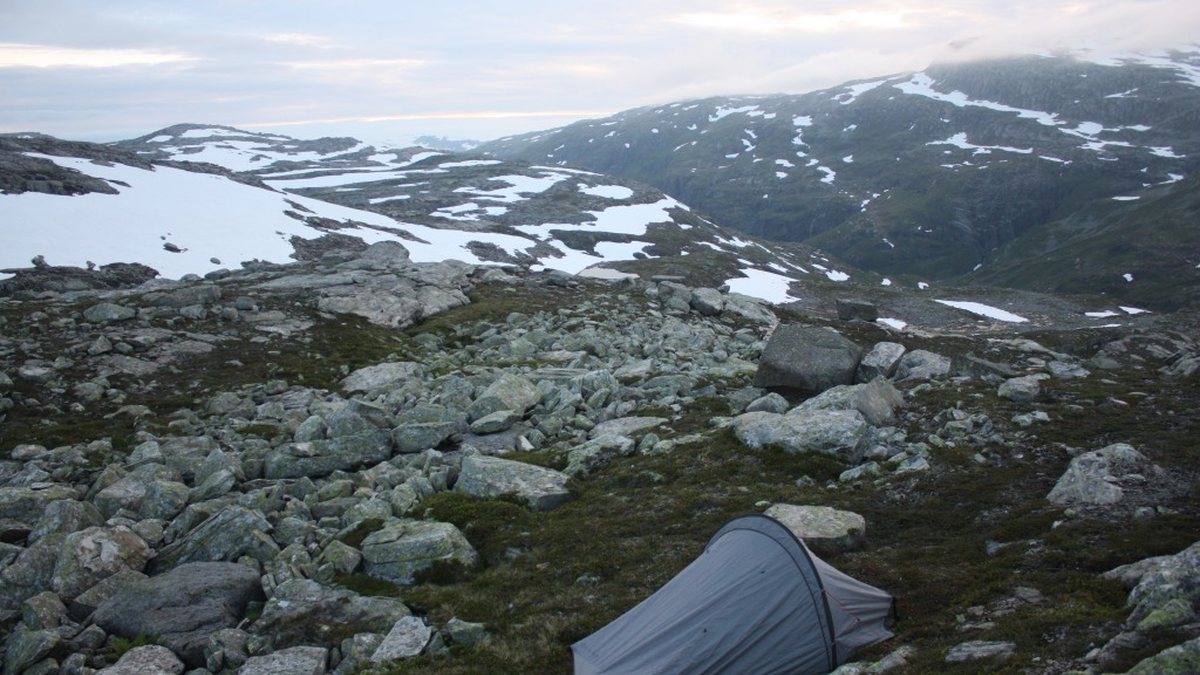
Under Norwegian law, you may pitch a tent on uncultivated land up to two days at a time, without asking the landowner, as long as you pitch at least 150 meters from inhabited houses. [6][15] Closer, and you must gain explicit permission, if even a tent near a house would disturb present inhabitants. [6]
Similarly, you must not leave your mark on the land—restoring the area as you found it. Nor can you camp where it would damage young forests, which is why Norwegian law limits picnics or camping where they'd pose such a harm. [7][13] Respect for the land extends to your stay length: once the two-night limit or 150 meters is surpassed, permission is required. [12][14]
Fires, Foraging and Everyday Outdoor Use
Foraging remains part of allemannsretten, granting the right to pick wild berries, flowers, mushrooms, and herbs on uncultivated land for personal use. [11] Yet, fires are generally prohibited in and near forests from 15 April to 15 September, when wildfire risks are high, and only made with a specific local authority's say-so. [8] Always, trash disposed of responsibly, the site left clean and clear. [3]
This combination of generous access with strict responsibility, in Norway's vision, maintains the delicate balance of civil access and sustainable countryside management under allemannsretten.
What Allemannsretten Does Not Give You
You cannot use motorised vehicles off-road, even for overnights in mountains. Allemannsretten cannot legally override motorised vehicles' restrictions. [9] And, note that specific rules vary by location, it is safer to hedge about current rulings, such as on drones, berry guidelines, or municipal-specific restrictions. local regulations may apply
Conclusion
Under allemannsretten, foreigners and Norwegians alike enjoy broad customary access to the nation's countryside, pitching tents, picnicking and making tracks across its forests, moors and coasts through the landscape. Yet this access comes with constraints, the privilege bounded by Norwegian real estate rules and the hard work of maintaining the countryside.